

Growing Wild Strawberry
Some people consider wild strawberry as a weed in their spotless grass. Not us!
Much to the dislike of my mother, we wouldn't let our father cut the grass in the house of my childhood, every May for as long as my sister, and I were young.
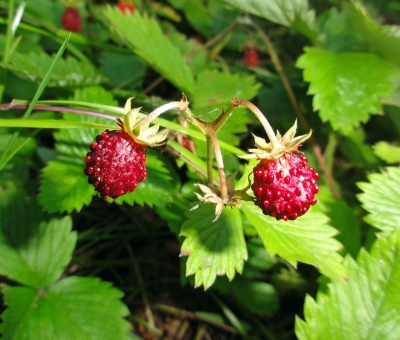
Stephan Barth / pixelio.de
You see, sprawling through the crabgrass and fescue were wild strawberries. Sure, we had a strawberry patch (often several) but even sun-ripened organic berries couldn't compete with the tiny, tart wild berries growing under the shaggy grass.
The Fragaria virginiana is the wild ancestor of cultivated strawberries. The small plant, with white flowers and tiny, red berries is actually a member of the rose family. The ripe fruit can be harvested from April through June. It is a perennial that loves filtered sunshine, and can often be found growing wild in old fields or on forest edges.
Good for your Skin, too
[an error occurred while processing this directive]
It has many uses, some of which date back hundreds of years. The leaves and roots have medicinal properties, and have long been used as an astringent. Strawberry juice is a folk remedy for blotchy skin, and leaf tea is a good source of vitamin C.
The berries also work well in cooking, although it can be tough to gather enough of these diminutive fruits to use for most recipes. If you manage to fill your basket, handle them extra carefully, as they bruise easily and must be cooked quickly, before they turn to mush.
If you're interested in growing your own wild strawberries, you can find plants at wildflower dealers, i.e. at Amazon.
How to grow your patch
They grow best in full sun to partial shade, and slowly form a sparse, evergreen ground cover. The plants reproduce mainly by sending out runners, but wild strawberry seeds grow true to type, so gardeners can increase the size of their gardens by planting the seeds from the berries they've grown.
Once established in the landscape, it's a hardy plant that will do well in most conditions, especially in locations where they are a part of the native landscape. There are few pests and diseases that affect the plants, although you may find it tough to keep the kids (and birds) away!